

As an Investigator Grants Analyst or Budget Developer, you will interact with many different functions, and it can be easy to lose track of who is responsible for what. Your job requires cross-functional collaboration across clinical operations, contracts, compliance, and site management teams. Each stakeholder brings their own specific lens to the table, be it clinical feasibility, legal requirements, operational readiness, or financial accuracy.
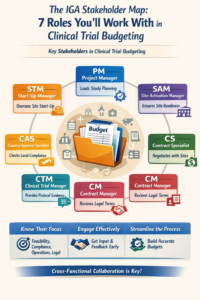
Success depends on knowing not just what each role does, but when to engage them and how they influence final budget and start up decisions. The table below summarizes the key stakeholders you are most likely to encounter during the development of your templates, their main focus, and how they typically interact with you. Understanding the clinical trial budget roles will help you anticipate feedback, route questions efficiently, and avoid unnecessary back-and-forth.
How to Use This Guide
Bookmark this guide as a quick reference when questions arise during budget development and study start up. Remember that role titles and responsibilities my vary from organization to organization but the logic behind them remains the same across CROs and Sponsors. When in doubt, start with your STM or PM to route complex issues appropriately. For site-specific budget questions, your CS is typically the first point of contact, while CTMs should be your go-to for protocol interpretation, procedural assumptions and clinical questions.
| Role | Focus | Responsibilities / Key Tasks | Interaction with IGA / Budget Team |
| STM – Start-Up Manager | Tactical start-up oversight | Ensures the study progresses according to plan during start-up; monitors site regulatory readiness, contracts, and training; reviews master budgets and payment schedules for feasibility | Reviews master budgets/payment schedules and provides feedback; escalates issues affecting site activation timelines |
| PM – Project Manager | Strategic study-wide oversight | Manages entire study lifecycle; coordinates across STM, CTM, CS, SAM, CM; ensures study timelines and milestones align with objectives | Ensures budgets align with study-level timelines and resources; signs off on assumptions affecting study-wide decisions |
| SAM – Site Activation Manager | Site-level readiness & operational execution | Tracks site approvals, contracts, training, and readiness; flags delays; bridges country teams, sites, and global ops | Flags budget delays or missing information that could slow site activation; ensures site budgets reflect local readiness requirements |
| CS – Contract Specialist | Site-facing negotiation | The “front line.” They negotiate local budgets and payment schedules directly with the sites. | They use your templates to build site budgets and will come to you for clarifications on specific line items. |
| CM – Contract Manager | Legal/compliance review | Ensures budgets and contracts meet sponsor standards; approves contract templates & legal language; client-facing | Provides feedback on master budgets and payment schedules to align with contract terms; ensures templates & compliance standards are followed |
| CTM – Clinical Trial Manager | Clinical & operational oversight | Provides medical/protocol guidance; ensures procedures, visits, and patient burden are accurate; supports decisions on complex protocol elements | Your best friend for technical questions. They advise on complex protocol elements and site effort assumptions. |
| CAS – Country Approval Specialist | Country-level compliance | Ensures site budgets comply with local laws/regulations; approves budgets before site activation; coordinates with CS, SAM, CTM, CM | Reviews master and site budgets for local compliance; requests adjustments to site fees, reimbursements, or admin charges |
Building strong working relationships with each of these stakeholders early in the study lifecycle will make budget negotiations smoother. Take time to introduce yourself, understand their communication preferences, and clarify expectations for turnaround times. Proactive communication prevents last-minute surprises and helps you deliver budgets that meet both sponsor requirements and site expectations.
Find out who I am and what I am fighting for.
If you agree, disagree, or think this is nonsense, email contact@clinicalbudget.com
If you’d like me to cover a specific topic, you can suggest it here.
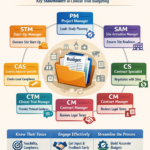
Find an infographic of what each role does below ↓