

Observational (or non-interventional) studies can be confusing at first and seem to go against most of the things you were taught as a clinical trial budget builder. In reality, they are one of the simpler protocols you can work on, as long as you correctly understand what is being paid for.
Many builders overestimate costs by adding unnecessary procedures. Others underestimate the effort involved by treating the study as pure data collection when often it is not.
This article walks through the full scoping process for observational budgets: how to determine what type of observational study you’re dealing with, what the standard components are, what gets added when the study isn’t purely observational, and the handful of edge cases that routinely catch people off guard.
Start With the Right Question
Before you start budget building or start reaching for CPT codes, there’s one question that determines the shape of the entire clinical budget:
Is this study entirely observational, or does it include procedures that the sponsor expects the site to perform and be paid for?
These two scenarios produce meaningfully different clinical trial budgets, and the distinction might not be immediately obvious. A study labeled “non-interventional” or “registry” may still include questionnaires, biomarker collection, or patient diaries that need to be coded and accounted for. A Phase IV study might be purely observational data collection with no procedures at all.
Your two sources are the study team and the protocol. Look specifically for answers to:
- Does the Schedule of Activities (SOA) list any procedures beyond data collection?
- Is there any language about questionnaires, assessments, or ePRO tools?
- Can you find any reference to sample collection, even if it’s described as “optional” or “if available”?
- Pharmacy references – is the sponsor providing the study drug, or is this a drug already on market that patients receive through normal care?
The Entirely Observational Budget
When the study is purely observational, the trial build is deliberately lean. You’re capturing the site’s cost of consenting, enrolling, and documenting patients who are receiving treatment as part of their normal clinical care. The sponsor is not directing their treatment – they are observing it.
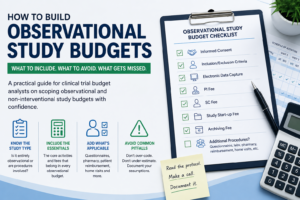
Activities to include:
- Informed Consent (INCO) – Always included. Even if it’s not listed in the SOE, every patient in any study requires informed consent. Add it once at screening.
- Inclusion/Exclusion Criteria (INEX) – Always included. This is the site verifying patient eligibility and it’s a real time cost that belongs in the Sponsor or CRO budget.
- Electronic Data Capture (EDC) – Always included. The site is entering data, and that data entry work needs to be compensated. Add it at every visit.
Other costs that should almost always be present:
- PI Fee – The investigator is responsible for overseeing every patient on the study, even when no procedures are performed. Unless explicitly instructed otherwise, include this at every visit.
- SC Fee – The study coordinator is the operational backbone of any study, and observational studies are no exception. Add this line unless instructed otherwise.
- Study Start-up Fee – This covers the administrative and regulatory setup work at site initiation.
- Archiving Fee – Sites are required to retain trial documents for years after the study closes.
That’s the foundation for a purely observational study – four activities and four “other” costs. Anything beyond this is either unnecessary or needs to be discussed with the study team.
When the Study Isn’t Entirely Observational
If the sponsor expects the site to perform procedures beyond routine data collection, those need to be coded and included. Below are the most common additions in partially observational studies:
Questionnaires and Assessments
Patient-reported outcomes, disease-specific questionnaires, and clinical assessments are common in these types of clinical research studies. Each one needs to be coded individually based on two key factors: administration time and administration type (self-reported, interview-based, clinical assessment, or standardized test).
Patient Reimbursement
If patients are physically attending clinic visits (as opposed to remote or phone-based check-ins) patient daily reimbursement or a stipend could be included. Add one unit per in-person visit. Do not include reimbursement for phone or telemedicine visits where the patient doesn’t travel to the site. If the study has a mix of in-person and remote visits, count only the in-person ones.
Pharmacy Costs
Think through whether pharmacy is involved. In a study where patients are already on a commercially available drug, pharmacy dispensing may still be required, if the sponsor is providing the medication through the site. If so, add a Simple Pharmacy Dispensing (for oral medications or standard injections) or a Complex Pharmacy Dispensing (for infusions or compounded preparations) line. If the drug is dispensed through normal prescription channels with no site involvement, pharmacy costs should not included.
Screening Visit Considerations
Not every observational study has a formal screening visit, but some do, particularly when eligibility confirmation requires a clinic visit separate from the baseline observation. Check whether the SOE includes a screening visit and, if so, what happens at it.
Home Healthcare Visits
When the protocol includes home visits by a healthcare professional you need to consider the following scenarios:
- If the protocol states that a vendor will conduct the home visits, do not include the procedure codes for those visits in the budget. Do include PI and SC fees – the site still has oversight responsibility, receives reports, and needs to review and record the information. The vendor costs sit in a separate agreement.
- If it’s not clear whether a vendor is involved, include the procedures for home visits at 50% and PI/SC fees at 100%. Document your assumption.
Incentive Fees
Occasionally an observational study budget will include a site or patient incentive fee – a flat payment for achieving enrollment milestones or similar targets. These are not standard and should only be included if explicitly requested. These can attract additional compliance scrutiny, particularly if the payment structure could be interpreted as influencing site or participant behavior.
Handling Ambiguity: The Default Position
If you’ve read the protocol and still cannot determine with confidence whether additional procedures should be included, you have two options:
- Reach out to the study team – if time allows for it, schedule a call and ask for clarification before building.
- Build entirely observational and flag it – if time is short or your study team is not responsive, build the minimal budget (should not take long) and state clearly in your assumptions that the study has been treated as entirely observational pending confirmation. Direct the reviewer to weigh in on whether additional items need to be added.
The second option is acceptable practice. What’s not acceptable is making a call either way without documenting it. Undisclosed assumptions are what turn a minor scope question into a back-and-forth after the budget has already been reviewed.
What to Document in Your Assumptions
Observational budgets are simple, but that doesn’t mean your assumptions should be lacking. A well-documented observational assumption set should address:
- Whether the study is treated as entirely observational or partially observational, and why
- The source of that determination (protocol, communication, or default assumption pending confirmation)
- Whether patient reimbursement was included, and if so, how the visit count was determined (exclude phone visits)
- Whether pharmacy was considered and the rationale for including or excluding it
- Whether questionnaires or assessments were included, with a description of each
- Any home healthcare visit assumptions made
Quick Reference
| Component | Always Include? | Notes |
| Informed Consent (INCO) | Yes | Screening visit; always, even if not in SOE |
| Inclusion/Exclusion Criteria | Yes | Screening visit |
| EDC | Yes | Every visit |
| PI Fee | Yes | Every visit; pause and think, if phone-only visit |
| SC Fee | Yes | Every visit |
| Study Start-up Fee | Yes | Once per study |
| Archiving Fee | Yes | Once per study |
| Patient Reimbursement | Conditional | In-person visits only |
| Pharmacy | Conditional | Only if sponsor-provided drug dispensed at site |
| Questionnaires/Assessments | Conditional | If in SOA |
| Screening Visit Components | Conditional | If protocol includes a dedicated screening visit |
| Incentive Fee | Only if requested | Per site or per patient – confirm before including |
Observational studies are the most forgiving type of budget to build for a CRO or a Sponsor, but they still require a deliberate read of the protocol before you start. The line between “entirely observational” and “partially observational” is where clinical builds get either over-inflated with unnecessary procedure codes or under-built because someone assumed the study title told the whole story.
Read the protocol, make a call, and document it. Everything else follows naturally.
Building clinical trial budgets and want to make sure nothing gets missed before QC? The Budget QC Checklist covers observational studies alongside more complex study types – a practical review tool for budget analysts at any level.
Find out who I am and what I am fighting for.
If you agree, disagree, or think this is nonsense, email contact@clinicalbudgets.com
If you’d like me to cover a specific topic, you can suggest it here.