


Here’s an experiment worth running at any organization with more than a handful of budget analysts: take one moderately complex protocol, hand it to three seasoned people and ask each of them to build a study budget from scratch and compare the results.
In my experience, you’ll get three defensible budget grids, each internally consistent and arguably correct but with slight variations and different solutions. As I usually say to people early in their careers – none of the three analysts are inherently wrong.
This is not a new issue. It has been quietly priced into the clinical trial budgeting and forecasting process for as long as budgets have been built – the variation usually gets smoothed out during review and negotiation anyway. It will, however, become a much bigger deal in the near future, for a very specific reason: AI-powered protocol ingestion tools need a single “correct” answer to learn from. Right now, most organizations don’t actually have one.
Why this stayed ignored for so long
When every template is built manually, individual variation or preferences are for the most part just noise. Reviewers catch the big issues, negotiations with the sites take care of the rest, and nobody sits down to ask “wait, why did Analyst A code this procedure differently than Analyst B did on a similar study six months ago?” There is no mechanism that would surface that question, because there is no single source of truth being checked against.
AI tools challenge that mechanism directly. When a tool generates a first-pass budget and an analyst corrects it, that revision is implicitly a vote for “this is the right answer.” If five analysts are making five different edits to the same type of line item across different studies, the tool either has to pick one as the standard, or it never converges, and accuracy plateaus regardless of how good the underlying model gets.
In other words: AI ingestion tools don’t create the standardization problem. They bring an existing, invisible issue to the forefront and a blocker to getting more value from the tool.
What the “correct” answer actually depends on
It’s worth being honest that in a lot of cases, there genuinely isn’t one universally correct approach – there is an answer that is acceptable to your organization, your team or even your QC-er. Things like:
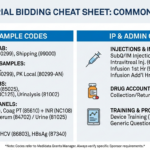
- Which code gets used when a protocol describes a procedure in non-standard language that maps to more than one plausible CPT code.
- How non-procedure activities (PI time, coordinator time, data entry) get categorized and which visits need to have increased effort.
- Where the line is between “this is part of the base visit cost” and “this is a separately billable add-on” (think review and interpretation of results or additional anesthesia).
Every one of these has been decided informally dozens of times by tons of different analysts, with slightly different answers – and all of those answers have been “correct enough” because nothing forced them to be compared against each other.
The fix isn’t more AI – it’s an internal style guide
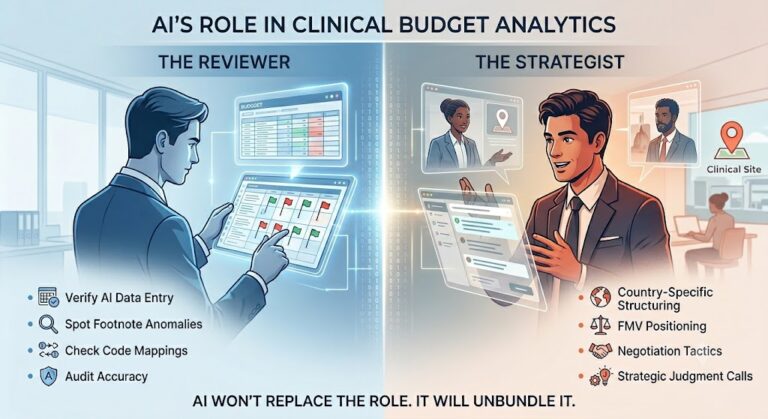
The organizations that get the most out of AI ingestion tools may not be the ones with the most sophisticated AI. They’ll be the ones that did the unglamorous work of writing down their own conventions first – essentially a budget-building style guide, the same way editorial teams maintain a style guide for grammar and tone even though any individual writer could “correctly” punctuate a sentence several different ways.
This doesn’t have to be exhaustive on day one. Even a short document covering the most common ambiguous cases – the procedures and code choices that come up again and again – gives an AI tool (and new analysts) a single reference point instead of “ask around and see what people usually do.” There is the added benefit of making review faster, onboarding new hires smoother, and reducing the awkward moments when a site or auditor asks why two studies handled the same procedure differently and nobody has a clear answer.
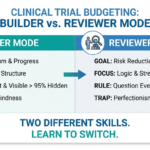
If your team is starting from scratch on this, the Budget Building and QC Checklists are a reasonable starting point – not a substitute for a full internal style guide, but a structured way to surface the decisions your team is making inconsistently before you sit down to codify them.” Positions the checklist as a diagnostic tool, not just a review tool, which broadens its use case.
The uncomfortable part
Writing this kind of document forces a team to actually resolve disagreements that have been quietly coexisting for years. Someone’s preferred approach is going to become “the standard,” and someone else’s equally defensible method is going to become “the thing we used to do.” That’s a harder conversation than it sounds, because nobody was wrong, there just wasn’t a reason to pick one before.
AI ingestion tools are going to push these inconsistencies center stage, surfacing every inconsistency as a tool-accuracy problem. The only choice is whether it happens deliberately, on a team’s own terms, or reactively, line item by line item, as a string of “why did the AI suggest something different than what I’d do” moments.
For analysts earlier in their careers, this is also a prompt worth sitting with: if your organization wrote down its conventions, do you know them well enough and would you contribute to that document? That kind of institutional knowledge – knowing not just what the standard is, but why it became so – is exactly what separates analysts who get pulled into process decisions from the ones who find out about them after the fact. It’s also, not coincidentally, the kind of thing that actually gets you promoted. The career progression series / transferable skills piece goes deeper on how to build it deliberately, rather than waiting to absorb it by osmosis.
Find out who I am and what I am fighting for.
If you agree, disagree, or think this is nonsense, email contact@clinicalbudgets.com
If you’d like me to cover a specific topic, you can suggest it here.