


Every few months there’s another vendor webinar promising that AI will “free up” clinical budget analysts to focus on “higher-value work.” I sat through one recently, focused on a tool that uses AI to read an uploaded protocol and generate a first-pass study budget – pulling out procedures, mapping them to billing codes, and building out a visit schedule, all in the time it takes to get a coffee and catch up on the office goss.
The pitch is the usual one: AI does the grunt work, humans do the judgment. What gets less attention is what this actually does to the budgeting and forecasting itself over the next few years. My read, after watching this unfold across a few tools now, is that “budget analyst” as a single title is quietly becoming two different jobs that happen to share a name.
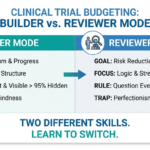
Job One: The Reviewer
This is the role that absorbs most of what used to be budgeting for CROs/Sponsors. Except now the building is done in minutes, and the work shifts entirely to checking it.
Reviewing an AI-generated first draft means:
- Confirming that every procedure in the schedule of activities actually made it into the budget, including the ones buried in footnotes or conditional logic.
- Checking that code mappings match your organization’s standards, not just a generic default.
- Catching the things AI tools openly admit they’re weak on – visit naming conventions, non-procedure costs, anything that depends on company-specific conventions rather than the protocol text itself, or “hidden” procedures.
The skill set here is pattern recognition and speed: knowing what “normal” looks like well enough to spot what’s off by a brief scan, rather than building from scratch. It’s closer to a clinical trial audit function than a construction role.
If this sounds like the QC work you’re already doing informally, I put together a Budget QC Checklist that turns this kind of review into a repeatable process – useful whether you’re checking your own work, a colleague’s, or an AI’s.
Job Two: The Strategist
This is the half of the job that AI tools aren’t even attempting yet, and according to the vendors themselves, won’t be for a while: country-specific cost structures, FMV positioning, negotiation strategy, and the judgment calls that come up when a site pushes back on a line item.
This work was always there, but it used to be squeezed in around the edges of protocol transcription. If the transcription work shrinks from “half the job” to “a quick review,” the strategist work doesn’t shrink – it just becomes a much larger share of what’s left. People doing this well will spend more of their week on FMV defensibility, applying country specifics, and actual negotiation prep, and less on data entry. At some point even strategist work will likely become AI-assisted, but today’s tools remain much stronger at protocol reading than negotiation judgement.
These Were Always Two Jobs, They Just Got Bundled
None of this is really new – plenty of fields have gone through this same split as automation matured: bookkeeping vs. controllership, paralegal document review vs. litigation strategy, junior underwriting vs. portfolio risk. Despite what you might be hearing, automation does not eliminate the lower-skill version of the job overnight, but it compresses it. The people who were doing both halves now have to pick which half they’re better at.
For budget analysts, the honest career question for the next four or five years isn’t “will AI take my job.” It’s “which half of my current job is going to get smaller”, and “have I been building skills in the other half?”
If you’re trying to figure out where your strengths actually sit, the role evaluation framework I wrote here is a reasonable starting point. If ‘strategist’ sounds closer to where you want to go, the Site Negotiator or CPM role profiles cover what that path tends to look like day to day.
If most of your strongest skills live in protocol interpretation and data structuring that’s worth noticing now. These skills remain important, but because they rely on structured information, they are the first targets for automation. If this is your focus, it is time to start building depth on the FMV, negotiation, and country-specific side. And if you’re earlier in your career and still doing a lot of manual protocol-to-budget work, there’s a real argument for treating that as a training ground for pattern recognition rather than the destination skill itself.
The job isn’t going away, but in a few years, “budget analyst” might be a less useful job title than “budget reviewer” or “budget strategist” – and which one you become probably starts getting decided now.
Find out who I am and what I am fighting for.
If you agree, disagree, or think this is nonsense, email contact@clinicalbudgets.com
If you’d like me to cover a specific topic, you can suggest it here.