


It has been a full month since the final master budget was approved. You prepared the country budgets in record time, they were reviewed and approved by the sponsor. The contracts with the sites have been fully executed. Even the Project Manager is happy! Looks like it’s smooth sailing from here!
But wait, what’s this? “Protocol Amendment 1, SOA changes – please see attached and assess budget impact”. But I thought my budget was accepted…
What Is a Protocol Amendment (PA) and Why It’s Not Your Fault
A protocol amendment in clinical trials is one of the most common and misunderstood events in study execution. So let’s get straight to the point – the amendment is not your fault, there is rarely a study without one and it is never caused by a budget mistake. From a budgeting standpoint assume protocol changes are normal, not exceptional. In my years of experience I have never seen a study without at least one PA.
A study amendment in clinical trials is a formal change to an approved study protocol that may affect procedures, timelines, patient eligibility, Schedule of Activities (SOA) or study design. PAs often require updates to budgets, contracts, and regulatory approvals. Most mid- to late-phase trials have at least one amendment. Zero-amendment studies are possible, but uncommon in complex, multi-country trials.
Protocol changes are usually driven by clinical, regulatory, or feasibility realities, meaning that you are likely to see one if there are recruitment challenges, safety findings or additional cohorts/arms are needed for one reason or another.
That being said, PAs are an issue multiplier – if your budget was built on shaky ground, the budget might make the amendment’s impact worse. A study with poorly documented assumptions or multiple issues makes a run-of-the-mill protocol amendment a stress test of remembering where an unlisted change in one country was made and if it was implemented in all of your templates.
Lastly, your manager likely sees PAs as an opportunity to redistribute the workload and involve newer colleagues in the work process without having them develop a new budget from scratch, so do not be surprised if some or all countries get transferred to someone else. Make sure you are prepared for a clean handover and remember that it is not a comment on your work performance if work gets shifted.
Admin Changes vs. Protocol Amendments: What’s the Difference
Let’s start off with something that looks like an amendment, feels like an amendment but it really isn’t one – admin changes. They are something that will be incorporated in the next PA. Below is an example of an Admin Change that had to be made because of a specific capsule shortage. Your job would be to determine if there would be any impact on the budget and communicate with the rest of the study team on how to proceed.
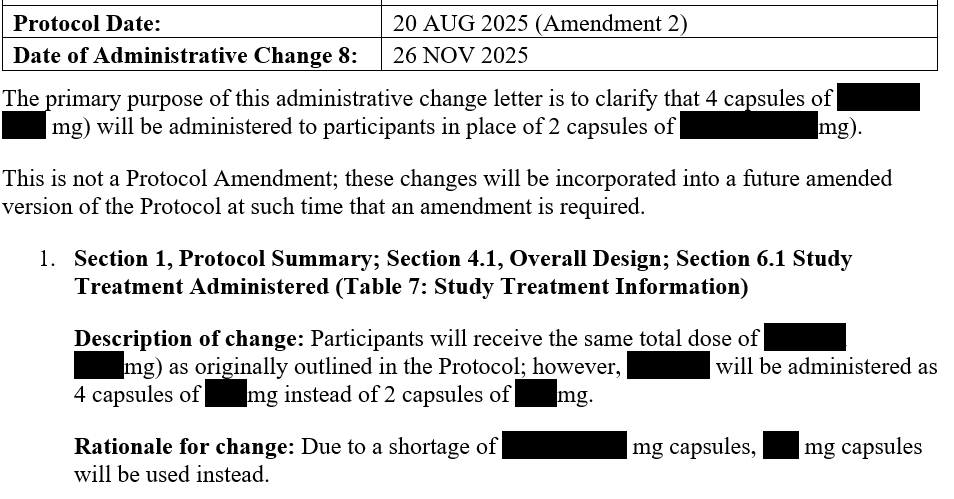
The actual implementation of an admin change is applicable only for sites under negotiation. That way the local teams can utilize the updated budget templates without triggering an amendment. Sites that are already fully executed (FE) will see the change implemented as of the upcoming protocol amendment.
Simple vs. Complex Protocol Amendments: How to Tell Them Apart
Similarly to the Admin Change, when we receive a notification for an amendment, we need to assess if there would be any impact on the budget. That would mean that we need to pay special attention to the SOA and check if there were timepoints or entire procedures that were added/removed, as well as other relevant protocol sections that might affect our build. Here is where having study documentation comes in handy – you can check which sections the builder referred to when drafting the grid and check them for updates. Bear in mind that amendments might be used to make additions to your country roster, without being specifically mentioned in the protocol – your study team can provide you more information if that is the case.
Note: An amendment might affect the entire study or just some countries/regions – be sure to pay attention to what the scope of the protocol change actually is.
Now that we have discovered that the PA will have an impact on the budget, we can distinguish between two subsections – simple and complex amendments. Discerning between the two is likely to have an effect on your templates or at the very least on site negotiations, as a lot of institutions like to have both options covered.
Rule of Thumb: If you must rethink the structure of the study, it is complex. If you are only adjusting quantities within the existing framework, it remains simple. Some sites might push for only having complex amendments in their budgets, however, that might lead to unnecessary overspending. Be Vigilant.
| Simple Amendments | Complex amendments |
| • Minor SOA or footnote adjustment • Clarification of wording • Small visit window change (i.e. naming) • Limited additional procedures Budget impact: • Limited negotiation • Minimal structural change | • New arm or cohort • New visits added • Dosing frequency change • Major eligibility shift • Extension of treatment duration Budget impact: • Structural rebuild • Revised country templates • Re-negotiations with sites • Updated payment schedules |
Note: Even a minor protocol amendment can affect visit frequency, CPT code selection, lab assumptions, and imaging requirements, forcing teams to revisit the original budget build.
How to Handle a Protocol Amendment: Your Step-by-Step Response
You now know that you will have to make changes to the budget, so let’s go over the amendment process. Your first order of business should be to get your hands on a redline (track changes enabled) version of the PA – there is no room for negotiation there. There is no point in going through the entire budget line by line the same way you did when you first built it. Your time is just as valuable as anyone else’s and if the study team does not provide you with a version of the amendment that can save you hours you are in the right to protest.
Then you need to perform what finance people call “Delta Analysis” – systematically determine what actually needs to be changed and prepare a list that can later be shared with the study team and negotiators. I also suggest highlighting and adding comments to the cells that need to be changed in any way. If there are a substantial number of changes that need to be made and you are worried that the probability of making a mistake is high, you can always reach out to your colleagues for a sanity QC, even if typically there isn’t a round of reviews for amendments in your organization.
Note: You can use the amendment as an opportunity to fix any shortcomings that the initial version of the budget might have had. Say a formula was wrong or a timepoint was missing – now is your chance to seamlessly make the necessary updates.
If you want a structured process that covers every stage of the amendment response workflow – from receiving the redline to distributing clean templates – the Protocol Amendment Checklist is built exactly for that.
Once you have prepared your draft version of the updated budget, list everything that was changed in an email and send it over to the study team for review. The more detail, the better! Include the tab where the change was made, add references to the protocol, be consistent in your color coding – anything that might help someone reviewing the updated file. Here is an example of what that might look like:
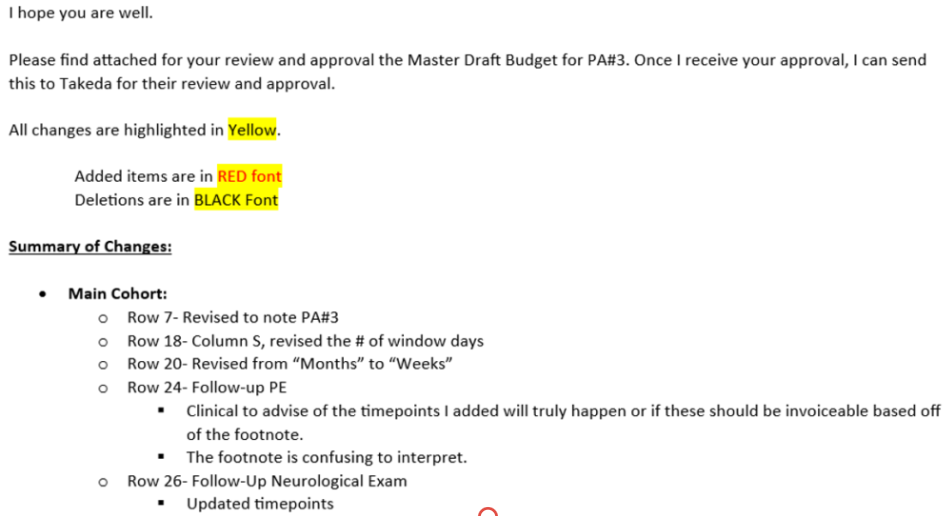
Once the study team has accepted the changes, prepare a clean version and share both the clean and the highlighted templates with your local teams/negotiators.
Last thing to remember is that having an amendment is generally not an excuse for a site to update their prices, even if the initial protocol was from a few years back – always try pushing back first!
Amendments Are a Feature, Not a Bug
Amendments are primarily scientific or operational decisions and we as budget builders do not create them, we simply respond to them. They signal a study’s evolution and experienced builders should anticipate rather than dread them.
Your job is not to prevent amendments – it is to be ready for them. A well-documented budget, clean assumptions, and consistent templates mean that when the notification lands in your inbox, your response is measured and methodical rather than reactive. That is what separates a builder who survives amendments from one who thrives on them.
Find out who I am and what I am fighting for.
If you agree, disagree, or think this is nonsense, email contact@clinicalbudgets.com
If you’d like me to cover a specific topic, you can suggest it here.