

If I had a dollar each time a site wanted to renegotiate the Screen Failure (SF) terms, I would probably be writing this article from my private jet.
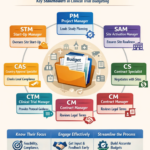
Every study you will work on needs to account for SFs and yet the language governing screen failure payments is one of the more frequently negotiated sections of a payment schedule. The PI is worried that caps/ratios would hinder their work; sites fear that they might not be compensated fairly; CROs (if they are acting as a paying agent) raise concerns how the payments will be made; sponsors need to make sure that expenses do not skyrocket due to an oversight in the language. Each stakeholder has a stake in the game which makes this section of the Payment Terms a hot area for debate.
This article covers how SFs affect the budget, the cap negotiation that comes up on nearly every study and the rescreening question that often gets conflated with it.
What is a Screen Failure?
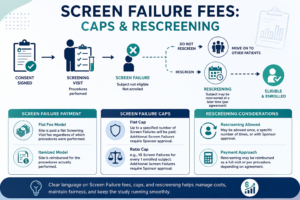
The language you use in your Payment Terms/Schedule A needs to clarify what falls within this category. Generally, a screen failure is a subject who provides informed consent and undergoes screening but is determined not to meet the eligibility criteria and therefore is not enrolled in the clinical trial.
This matters because screen failure invoicing is somewhat different from a “normal” visit. A SF is typically a single flat reimbursement equal to the full screening visit amount in the budget regardless of which specific procedures happened to be performed before the subject was deemed ineligible. The simplification exists because screening procedures vary subject to subject (one person might fail after labs come back, another after an ECG), and itemizing every partial screening would create more administrative overhead than it’s worth for either party. This also means that it is pretty simple to automate the payments for this visit.
Note that, this does not mean that all sites use this flat fee approach every time. There could be a scenario where sites send a breakdown of all procedures that have been performed or they could even list the tests that have been carried out on top of the standard Screening Visit.
Screen Failure Caps: Flat Cap or Ratio?
This is where most of the actual negotiation time goes into. On the Sponsor side, there needs to be some sort of mechanism to manage the number of SFs performed. Uncapped screen failure payment is a real cost exposure, particularly on studies with strict inclusion criteria or rare-disease populations where failure rates run high. Sites, on the other hand, often resist caps reflexively, worried that a stated limit will be read as a hard stop on their ability to keep screening patients.
Both concerns are legitimate, and the resolution is usually a structured compromise rather than a flat no-cap or hard-cap position. Below are examples of standard language that you may refer to – I offer two options – a flat cap and a ratio. Notably, the underlined sentence is what typically convinces sites to accept this provision.
Payee will be reimbursed for a maximum of ten (10) Screen Failures screened in accordance with the Protocol. After the limit of ten (10) Screen Failures has been exceeded, the Investigator shall obtain Sponsor’s consent to continue screening.
And:
Payee will be reimbursed for ten (10) Screen Failures for every one (1) Evaluable Subject enrolled in accordance with the Protocol. Additional Screen Failures will be paid upon written Sponsor approval.
The key clause in both versions is the same: exceeding the cap doesn’t require a contract amendment, just sponsor consent to continue. Sites often read “cap” as “you will stop paying us and tell us to stop screening.” What the language actually does is introduce a checkpoint – the sponsor gets visibility and a chance to weigh in before costs run further, but screening isn’t prohibited past the set limit. Once a site understands that distinction, caps become much easier to agree to.
If a site still won’t accept any cap, having screen failure rate data from comparable studies in the same indication could be a useful tool – it lets the sponsor see that an uncapped site on a similar trial didn’t actually generate runaway costs in the past. That makes the sponsor more comfortable agreeing to flexibility rather than holding a hard line that stalls the negotiation.
The cap conversation can feel like friction for friction’s sake when you’re in the middle of a negotiation, but it’s solving a real problem for both sides: the sponsor needs cost predictability, and the site needs assurance that hitting a number on paper doesn’t mean their study work stops. Once both parties understand that the cap is a checkpoint rather than a wall, the rest of the conversation usually moves quickly.
Our PI won’t accept a cap.” The “Site Asked for More?” Playbook has the exact replies for removing the cap (Card 18) and for rescreening requests (Card 19), the one that quietly undoes the cap.
How Should Rescreening Be Paid?
Often, the rescreening gets confused with the screen failure cap conversation, but it is answering a different question entirely. Rescreening governs whether a specific subject who already failed screening once can be screened again.
There are two common approaches, and which one a sponsor prefers usually comes down to risk tolerance around protocol deviations and patient burden.
The preferred, more flexible version:
A Screen Failure may be rescreened at the Investigator’s discretion, if at some point in the future the subject is expected to meet the participant eligibility criteria, following a discussion with the Sponsor or designee. Institution will be reimbursed at the rates set forth in the Budget. The rescreened patient will be given a new participant number and reimbursement will be based on data entered in the eCRF.
The stricter version,
Used when a sponsor wants tighter control over how many times a single subject can cycle through screening:
Subjects who do not meet the criteria for participation in the Study may be rescreened once, after discussion with the Sponsor or medical monitor. Rescreening will be reimbursed on a per procedure basis at the rates set forth in the Budget for the Screening visit, based upon the receipt of correct and itemized invoices.
Rescreening caps should be addressed separately from the overall Screen Failure cap. A site may be allowed to rescreen a subject once, a defined number of times, or with Sponsor approval after each attempt. The payment terms language should clearly specify the permitted number of rescreening attempts and whether each attempt is reimbursed as a full Screening Visit or on a per-procedure basis. Without a defined limit, repeated rescreening of the same subject can create unexpected costs and make the original Screen Failure cap less effective.
Want a structured way to make sure screen failure language, rescreening provisions, and cap logic are all accounted for before a budget goes to QC? The Budgeting and QC Checklist walks through payment schedule consistency alongside the core budget build.
Find out who I am and what I am fighting for.
If you agree, disagree, or think this is nonsense, email contact@clinicalbudgets.com
If you’d like me to cover a specific topic, you can suggest it here.
I write this site in my spare time, and the articles will stay free. If one of them helped, [buying me a coffee] is a nice way to say so.