
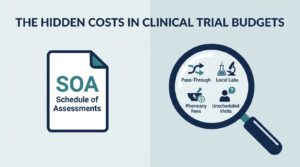

You’ve read the protocol, you have mapped every procedure in the Schedule of Assessments (SOA). Every visit has a column, every procedure has a cost. Your formulas look good and the totals are correct. Then the QC-er or the Study Team comes back with a list of things that are nowhere to be found in your budget and the more you look at their comments the more they make sense.
A truth you will quickly learn, is that the costs you miss are rarely hidden in the SOA. If you’ve learned to read a protocol properly, you know the importance of thinking beyond it and how you need to be ever vigilant of the hidden traps that can hurt your budget.
Here’s where to look.
Costs Triggered by Events
The Protocol and SOA are the backbone of the study and show what should occur when everything goes according to plan. Your role is to realize that things rarely move smoothly and you have to anticipate any additional costs.
Events that burden your budget but don’t fit in a visit column include:
- Unscheduled visits. Patients come in for safety checks, repeat labs or dose adjustments.
- Screen failures and re-screening. Every study has them, and the payment language is one of the most negotiated sections of the payment schedule.
- SAE reporting and follow-up. Each serious adverse event means reports, follow-up and documentation for the coordinator and PI.
- Re-consent. Every amendment that changes the ICF means re-consenting every active patient.
- Phone visits. A subject may need to call in with a question or need additional information. You need to consider adding appropriate staff time to cover such a scenario.
These costs may not appear as routine visit columns in the SOA. They belong in the invoiceables section in one form or another (depending on your organization). If your budget does not account for them, you might have to do additional work down the line.
Costs That Depend on Questions You May not have Asked For
This is the biggest category, and it could be completely missing from the protocol. For this reason, I ask the study team a standard set of questions, because each answer changes what the budget looks like:
- Central or local lab? If both, which assessments go where? A local lab means lab costs in the site budget. A central lab means sample handling and shipping instead. (See Central Lab vs. Local Lab.)
- Is there a patient travel vendor and, if so, are there sites/countries that will not be using their services?
- Is frozen shipping required, and is dry ice provided? If the site has to source dry ice or ship frozen samples itself, that’s a recurring cost per shipment.
- Is the sponsor supplying equipment such as ECG machines or blood pressure monitors? Does the site have to return it, or can it keep it?
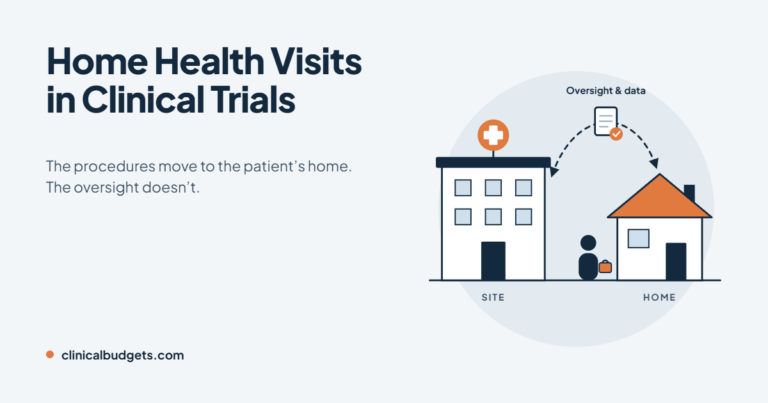
- Is home health care planned, and is there a vendor? This decides whether the procedures sit with the site or a vendor.
Costs Owned by Other Departments
The site budget is negotiated with the study team, but some costs are set by departments that often do not negotiate and have their own fees:
- Pharmacy. In some countries, hospital pharmacies charge separately for set-up, storage, dispensing and destruction, on their own price list.
- Ethics committees. Is the IRB central or local? Who pays, and how? In the US, local IRB fees are often invoiced by the site. In the EU, ethics committee fees and payment arrangements vary by country. Confirm whether the fee is paid centrally, invoiced separately, or included in the institution’s budget.
- Records and archiving. Sites have to store study records for years after close-out, and many charge for it, either as a one-off or per year. Look for more information on the period and discuss with your CTM what storage options there are in case the requested fees are over budget, i.e. sponsor-managed storage after an agreed period or a shorter retention period where legally and contractually permissible.
- Start-up and administrative fees. These are institutional fees that exist regardless of the protocol. (See How to Evaluate and Negotiate Start-up Costs.)
Costs Required by the Country, Not the Protocol
Some costs come from local rules, not from anything the protocol says. If you work for Latin America, you may recognize this example: a site in Brazil asked me to add contraception reimbursement for patients, citing national ethics requirements.
The fix was a pass-through line, reimbursed at actual cost on invoice and capped at a monthly amount per patient. I set the cap after checking typical local prices for common contraceptives, with a small buffer to avoid repeat escalations. The lesson isn’t about Brazil’s contraceptives or Italy’s Stamp tax specifically. Country requirements can turn a protocol instruction into a budget line, and the master budget won’t warn you.
The Opposite Mistake: Paying Twice
Once juniors learn about hidden costs, some overcorrect and start adding everything. Watch for double dipping:
- A start-up fee that already covers activities you’re also paying per patient.
- Coordinator time that sits in overhead and as a separate line.
- Home visit procedures paid to both the vendor and the site.
The Bottom Line
The protocol and SOA tell you what should happen during the study. They don’t necessarily tell you who will pay for it, which department owns the cost, or what happens when things don’t go according to plan.
A complete budget requires more than mapping procedures. It means anticipating event-driven costs, asking the study team the right questions, checking country-specific requirements, and making sure every cost is covered exactly once.
Use the Budget QC Checklist to help identify gaps before submitting your next budget for review, and read Why Clinical Trial Budgets Fail QC (and Five Steps to Avoid It) for a broader look at common QC problems.
Find out who I am and what I am fighting for.
If you agree, disagree, or think this is nonsense, email contact@clinicalbudgets.com
If you’d like me to cover a specific topic, you can suggest it here.