

Why Budget Roles Feel Harder Than They Should
Let’s imagine a scenario that might sound familiar:
You’ve been in your clinical trial budgeting role for six months. You are starting to feel comfortable working with the Protocol and the Schedule of Activities and you have no trouble finding the CPT codes for the procedures you need. You might have developed your first country budget or you might have worked on something smaller like an amendment and despite some reworks you think you might be getting the hang of this!
Until one fateful evening. As the working day comes to a close you get an email – there is a substantial mistake in one of your budgets and it needs to get fixed ASAP! Your mind starts racing! How could this have slipped by you, it’s so obvious… Is this mistake present in all of your country and site templates? Are they final or still under negotiations? Did your manager hear of how much you messed up? Should you be updating your CV and start looking for a new job? How silly of you to think you were meant for this job!
You try to fix things immediately and start working longer hours, but more and more work keeps piling up. Your sleep suffers as you struggle to “shut off” at night. You feel increasingly agitated and irritable, and your relationships with people around you become strained.
This is how you burn out. The fact of the matter is that all of the above is a flaw of the system, not so much of you as a professional. Even people with a decade of experience behind them are not immune to making mistakes. The difference is they have experience with ambiguity, not absolute infallibility.
To start off, the training you received probably focused on the systems and templates you will be using. The truth is that there are tons of specifics, gray areas and multiple valid approaches that either need to be better incorporated into training, or simply take time to learn
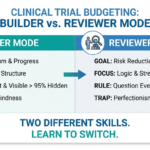
The result is that you were taught how to build, not how to think and what you need to be mindful of. It might feel like incompetence even when it’s not.
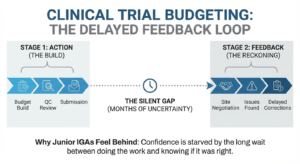
A major factor in you feeling inadequate is the delayed feedback loop. Rarely do you get immediate feedback if a budget is “correct” in its entirety. Even though it will pass several rounds of QC, mistakes do slip by and they become apparent several months down the line, typically when one or more sites do a deep dive in the protocol and something pops up. You probably work on a project alone without a more senior person looking after your every move, so you are unable to get immediate notes on how you handled a situation.
You will also notice that you will get scolded for mistakes while success often looks like “nothing went wrong” – a missed line gets immediate attention but a well-anticipated potential problem goes unnoticed. We calibrate confidence through feedback but the way budgeting in clinical trials work you are starved of it until something needs fixing.
Feeling behind or overwhelmed is a sign you understand the complexity of this role and seniority reduces anxiety by pattern recognition, not perfection.
The work doesn’t get easier; you get better.
What actually helped me:
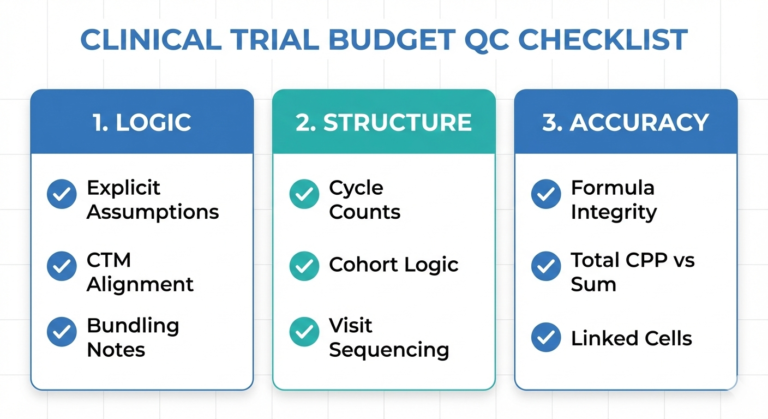
- Externalize thinking – use checklists, notes, or diagrams
- Ask “why” questions, not just “how”
- Review old budgets and outcomes – try to see patterns and lessons learned
- Separate accuracy from confidence – making a mistake is a technical error, not a character flaw
- Seek feedback on reasoning, not just outputs
Find out who I am and what I am fighting for.
If you agree, disagree, or think this is nonsense, email contact@clinicalbudget.com
If you’d like me to cover a specific topic, you can suggest it here.