
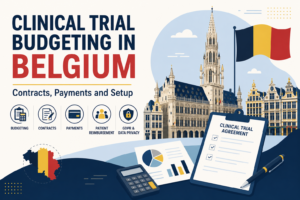

Belgium has a regulatory and contractual infrastructure that demands a thorough setup, documentation, and more coordination before a single contract can be finalized than almost anywhere else in Europe. The country specific development process here is robust and I advise lessons here be used as a baseline applied to other countries you work on in order to minimize delays and snags.
The good news is that none of it is unpredictable – every requirement has a logic, and once you understand what Belgium actually needs, you can plan for it rather than be derailed by it.
This article covers the key Belgium-specific considerations that affect the budget and contracting process: the timeline constraint that governs everything else, patient reimbursement, GDPR specifics, the withholding issue, where Power of Attorney (PoA) comes in and the practical setup steps that need to happen before the budget building team team can do its job properly.
The Timeline That Governs Everything
Belgium operates under a 106-day regulatory assessment timeline from the date of submission. In the Belgian process we work with, contracts are targeted for full execution within 120 days of submission.
What that 120-day deadline actually requires is that every party in the chain – the Country Specialist, the budget team, the site, and the Sponsor – works with minimal turnaround at every step. The timeline can only be met when:
- All parties can review contracts in the minimum amount of time
- Comments from every reviewer are adequately justified and responded to without unnecessary delay
- It is highly recommended that escalations are submitted to the next link in the chain within two business days of receipt
That two-business-day escalation requirement is worth underlining. In most countries, a longer delay in escalating a site pushback or a sponsor comment is merely an inconvenience. In Belgium, it can push the entire timeline past the window and create a study-level problem.
This also means that Belgium studies benefit significantly from being set up correctly from the get-go. Every delay caused by missing documents, incomplete templates, or unclear reimbursement policies at the beginning compounds into a larger problem later. The time to clarify how patient compensation or drug reimbursement will be handled is before these questions arise, not after.
What You Need as you are finalizing the country budget
Belgium has an unusually comprehensive list of upfront information requirements, and the country specialist may request all of it before meaningful budget negotiations can begin. The budgeting team needs to be aware of these dependencies because delays in receiving this information are delays in the budget, therefore delays in the contract and the finger may be pointed at you.
Vendor and materials list – Sites in Belgium may want to know the complete list of vendors involved in the study and the nature of any training those vendors require. They use this information to calculate training costs in the budget and to populate internal sign-off forms required for pre-submission. They also need to know what equipment and materials will be supplied by the sponsor, because this directly affects what procedures they perform and therefore what goes into the budget.
Draft manuals – Sites in Belgium routinely request draft pharmacy, laboratory, and radiology manuals before agreeing to the budget. They need to understand the number of samples, preparation requirements, training obligations, and vendor submission requirements before they can confirm their costs. The recommendation is not to wait for final versions – draft manuals are sufficient for this purpose, and waiting for finals delays the entire setup. If a request like this end sup in your mailbox, be sure to forward this to the clinical team, as they are the ones that can provide them.
CTA, budget, and payment schedule templates – These should be provided to the country specialist as early as possible. Every deviation from standard language will generate additional negotiation time so the fewer non-standard clauses the sponsor insists on, the faster the process moves.
Patient Reimbursement: A Known Source of Delay
Patient reimbursement in Belgium has specific requirements that have caused delays, amendments, and misaligned documentation on multiple studies I have worked on.
As you are probably aware, reimbursement goes through the institution directly or through a third-party vendor. Notably, if a third-party vendor is involved, the payment schedule must include language covering both reimbursement through the institution and reimbursement through the third-party vendor. Patients should not be required to use a third-party vendor where applicable privacy concerns prevent them from doing so – they must have the option to receive reimbursement through the institution instead.
Beyond the mechanics, Belgian sites and ethics committees have clear preferences about how reimbursement is structured:
Consistent reimbursement across Belgian sites. Reimbursement should generally be consistent across Belgian sites for comparable expenses. The current Belgian Association of Research Ethics Committees (BAREC) guidance allows some variation between centers where geographic or other legitimate cost differences justify it, but expects differences within Belgium to remain relatively small.
Fixed fees are strongly preferred over variable fees. Sites and ethics committees prefer reimbursement policies that do not require patients to collect, submit, and have receipts reviewed. The operational burden of receipt-based reimbursement on site staff is significant, and sites push back on it consistently. Fixed per-visit reimbursement rates avoid this problem.
Higher amounts for exceptional circumstances. If a particular patient requires more than the standard amount (distance, taxi requirement, specific need), this can be approved on the basis of a site statement, with the sponsor’s explicit written approval, on a case-by-case basis.
The reimbursement policy – the amounts, the means, the circumstances – needs to be agreed upon at the very start of the study so that the Informed Consent Form (ICF), the Clinical Trials Information System (CTIS) form, and the contract are all aligned. Discrepancies between these documents is one of the most common causes of mid-study amendments in Belgium.
Withholding: A Frequent Negotiation Issue
In my experience, Belgian sites strongly push back on withholding or holdback provisions, particularly where they defer payment pending final reconciliation. They expect to be paid for every procedure they perform, and the payment schedule cannot contain holdback provisions that defer a portion of payment pending final reconciliation.
This is worth flagging to the sponsor early. Sponsors who use standard global templates with withholding language need to know upfront that Belgium will require a local carve-out. Trying to hold the line on withholding in Belgium is a reliable way to stall the contract negotiation entirely.
Site Costs and the One-Push Rule I Have
By default, most Belgian sites do not provide cost documentation for site fees. The country specialist should maintain a local database of non-negotiable site-specific fees from previous studies, which helps the budgeting team understand what is genuinely fixed versus what has room to move.
My adopted approach for departmental costs presented as non-negotiable is to push back once. If the site maintains that a cost is non-negotiable after one round of pushback, it is not worth wasting time to go back and forth repeatedly on costs the site has already declared fixed – it consumes time that Belgium cannot spare, and it damages the working relationship with sites that will be needed on future studies.
Bank Transfer Fees – The Tiny Detail that Causes Large Problems
Intermediary banking fees on international SWIFT transfers can result in Belgian sites receiving slightly less than the invoiced amount. From what I’ve seen, these discrepancies are typically small but can lead to payment queries.
This is a recurring issue in Belgium specifically. When a site raises a payment discrepancy, this is often the explanation rather than a processing error. It’s worth being aware of before the first payment cycle, not after.
The Power of Attorney in Belgium – Specific Requirements
Belgium requires a signed and dated Power of Attorney (PoA) from the sponsor authorizing the CRO to negotiate and execute contracts on their behalf. This is not unusual but Belgium’s requirements for what that PoA must contain are specific, and a PoA that doesn’t meet them will need to be revised, which costs time you don’t have.
The PoA must include:
- Full name and address of the sponsor and the sponsor’s EU Legal Representative (only one can be appointed)
- Study identifiers
- The exact legal name and address of the conducting CRO
- The specific tasks for which the PoA is issued
Critically, the PoA must explicitly state that the CRO has the authority to bind the sponsor to the obligations of the agreement – not merely to negotiate, but to commit. Belgian sites and ethics committees are firm on this. If the PoA only authorizes negotiation without binding authority, sites will flag it and the contract cannot proceed until it’s corrected.
Belgian hospital legal departments strictly enforce the “binding authority” clause to eliminate legal ambiguity over final financial and operational liability. Without explicit language authorizing the CRO to commit the sponsor, sites risk executing an agreement with an agent whose promises the sponsor could later disclaim or dispute. Explicit binding authority ensures that all contract terms negotiated by the CRO are immediately and directly enforceable against the sponsor under Belgian law.
Standard language that works in this context:
Sponsor authorizes CRO, acting on Sponsor’s behalf or acting on its own behalf, to negotiate and enter into a clinical study site agreement and other ancillary documents needed to support the conduct of the study. Sponsor has authorized CRO to bind Sponsor to the obligations directly imposed on the Sponsor therein. Sponsor hereby agrees that it shall honour all of its obligations set forth in the Agreement.
A multi-country PoA can be used in Belgium, provided it contains this binding language. The PoA does not need to be apostilled or notarized. A scanned PDF copy suffices – no original is required.
Get this document before the study starts. Chasing a PoA revision mid-negotiation in Belgium is exactly the kind of delay the 120-day window cannot absorb.
GDPR: Belgium Has a Specific Stance
Belgium’s GDPR requirements go beyond the standard EU provisions that most sponsors are already familiar with. The country specialist will ask for specific information before drafting the contract, and the team should be aware of what’s being requested and why.
The key questions that need to be answered at study setup:
- Data Privacy Officer (DPO) contact details – contact information for both the sponsor and the CRO must be available for the first draft of the contract. Belgian sites’ GDPR legal specialists will review this immediately.
- Data Processing Agreement (DPA) format – it should be a separate document or incorporated into the main CTA, and whether a sponsor-specific template is available or required.
- Signature authority for the DPA – whether the sponsor signs the DPA directly or whether the CRO signs on the sponsor’s behalf, covered by the PoA.
- Data protection roles – Confirm the respective GDPR roles of the sponsor, institution/investigator and CRO for the study. Belgian clinical-trial guidance has described the investigator as a processor in certain contexts , but the appropriate GDPR role should be assessed based on the actual processing arrangements.
- Third-country data transfers – if study data will be sent to the United States or other countries outside the EU, Standard Contractual Clauses, Transfer Impact Assessments, or confirmed participation in the Trans-Atlantic Data Privacy Framework will be required. Belgian sites will raise this, and having the answer ready at the first draft stage saves significant time.
None of these requirements are unusual from a compliance perspective but Belgium’s sites and ethics committees apply them rigorously. Not having answers to these questions at the start of negotiations is a reliable way to generate revision cycles that push the timeline past the alloted window.
The Setup Checklist
Given the volume of upfront requirements Belgium generates, treat study setup as a checklist rather than a linear process. Before the budgeting team can meaningfully begin work on a Belgian study, the following should be in place:
- CTA template, budget (with parameters), and payment schedule templates provided to the country specialist
- Complete vendor list with training requirements documented
- Equipment and materials list provided by the sponsor
- Draft pharmacy, laboratory, and radiology manuals
- A PoA for Belgium meeting the specific requirements above – signed, dated, with binding authority language
- Patient reimbursement policy agreed: amounts, means, hybrid provision, fixed vs. variable structure
- GDPR information: DPO details, DPA format, signature authority, third-country transfer position
- Sponsor’s position on withholding confirmed and prepared for removal from the Belgium-specific documents
Belgium is not a country to set up reactively. Every piece of missing information at the start is a delay at the end and with a 120-day hard deadline, there is no slack to absorb those delays.
Working on a multi-country study with other complex budget structures? The France and UK country guides cover the other two European countries that most reliably slow down the IGA process – each for completely different reasons.
Find out who I am and what I am fighting for.
If you agree, disagree, or think this is nonsense, email contact@clinicalbudgets.com
If you’d like me to cover a specific topic, you can suggest it here.