

If you build global budgets, Japan is the country that doesn’t fit the template. While most countries give you a grid you can check against your Schedule of Events (SOE/SOA) and your FMV tool of choice, Japan gives you a cost per patient, a handful of institution fees, and a note that medical expenses will be billed separately.
Japan has priced clinical trials its own way for decades, and it is now part-way through a national shift toward the FMV-based approach the rest of the world uses. This article covers what a Japanese budget looks like, why it’s built that way, and how the switch to FMV changes the way you build one.
What a Japanese Site Budget Looks Like
The points table. The institution scores the study on characteristics such as disease severity, design and blinding, treatment duration, number of visits, and the volume of tests and samples. It then converts those points to yen.
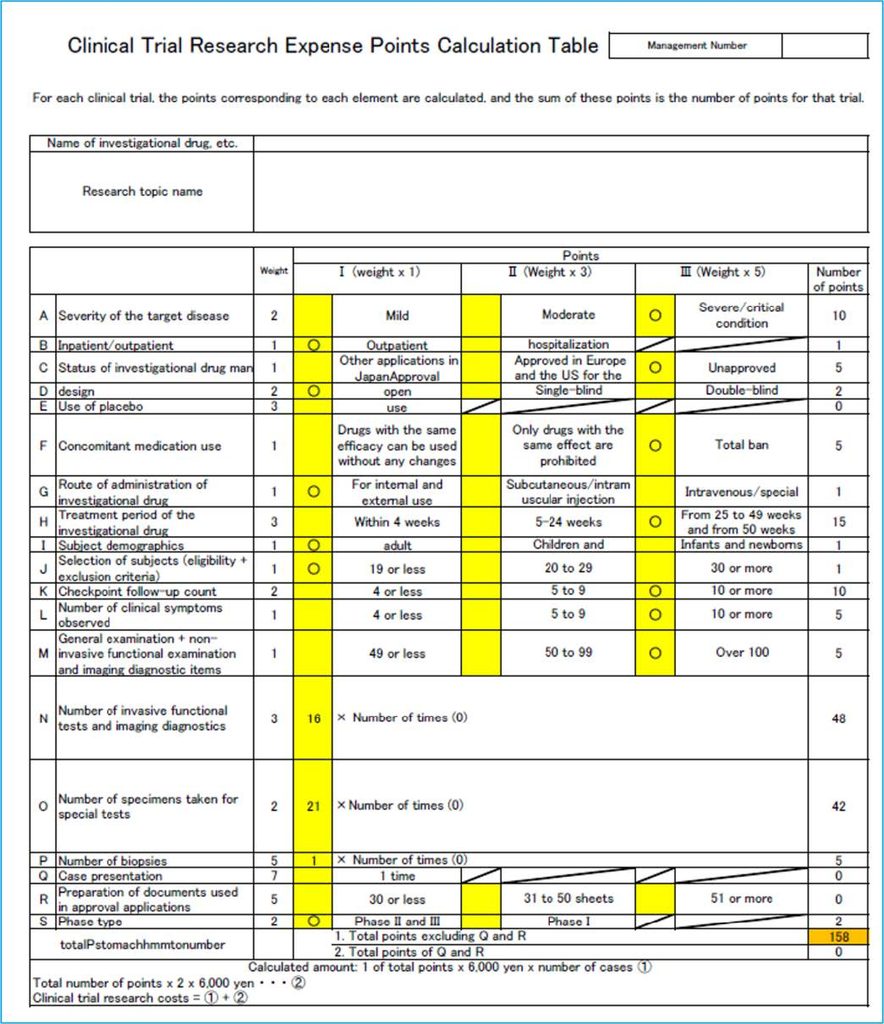
The table above is an example of a point table for a medical institution’s IP management fee for a certain trial. Each medical institution has its own point calculation table. The categories are similar but have different weights and points.
IP management costs: 58 pt x 1,000 = 58,000 yen / patient
This amount is the total IP management fee per patient. It is the pharmacy’s fee for storing and prescribing the investigational drug. Payment methods vary from medical institution to medical institution, and in addition to being distributed per visit, some institutions may be required to pay a portion in advance as storage fees.
Not every institution uses the same table, or even the same yen value per point. The industry association has told the Ministry of Health that three common points tables coexist with many institution-specific versions. Some scored elements aren’t quantitative, two institutions using the same table can reach different point totals, and point values of 6,000, 8,000 and 10,000 yen are all in use.
Payment follows milestones rather than necessarily tracking every visit. Japanese institutions may use milestone-based payment schedules, with payments triggered by defined points in the study rather than by each completed visit, the exact structure varying by institution. Depending on the payment schedule and the rules for discontinued patients, a site may retain payment for work that has not yet been performed. For budget developers, the key is to understand the payment triggers and discontinuation rules rather than assume that the per-patient amount is paid strictly in proportion to completed visits.
The sponsor pays part of the medical bill. Japan’s national health insurance generally doesn’t allow insured and uninsured care to be mixed in one course of treatment. Clinical trials get a formal exception, and the price of that exception is that the sponsor picks up certain costs directly. In an industry-sponsored trial, the company pays for all tests and imaging, typically from the first to the last dose of the investigational product, while insurance keeps covering routine care. Because these costs vary from patient to patient, the contract doesn’t state an amount but they’re still billed to the sponsor.
Sites rely on SMOs. A Site Management Organization contracts with a specific institution to support its trial work, operating on the institution’s side rather than the sponsor’s. A speaker from CMIC, a Japanese CRO/SMO, put SMO involvement at roughly 70% of trial sites in Japan. Coordinator costs therefore often sit outside the institution’s budget entirely.
Why this matters for global studies. Industry has published data on the consequences. An Eli Lilly Japan analysis of global trials found three problems.
- Wide variance between sites. Per-patient costs for the same protocol varied widely across Japanese institutions, with several trials showing a gap of more than four times between the highest and lowest site.
- Points don’t track complexity. Japanese research-expense points correlated poorly with the complexity scores used abroad.
- Japan budgets can’t be easily compared to US study costs. The UK, France, Germany, Australia, Korea and Taiwan all tracked US per-patient costs somewhat closely, while Japan did not
Why Japan Is Different
According to Pacific Bridge Medical, the points table approach is used only in Japan, and each site sets its own point value. Japan’s neighbors moved to benchmark pricing long ago. R&D Head Club even lists the growing competitiveness of other Asian countries, which already use the international standard, as one of the pressures on Japan to change.
At the same time, Japanese institutions have far more control over pricing than sites elsewhere in the world. Under Japanese Good Clinical Practice (GCP), the trial contract is signed by the institution itself. The site therefore has the power to set the terms. Additionally, as mentioned above, there is no national price list. Each institution adopts a points table and adjusts it as it sees fit giving a lot of financial control to the site.
FMV Tools Do Not Have Good Japan Data Yet
For global studies benchmarking tools such as GrantPlan and GrantsManager, determine what falls within FMV based on historical data and a lot of fully executed contracts. They are built from procedure fees that sponsors and sites actually agreed on, and each sponsor’s newly agreed costs flow back into the database. Japan’s contract history gives FMV tools very little to learn from so most procedure-level prices for Japan are largely estimates, and they can be off in either direction. Based on personal communications with the data teams that govern Japan costs, it might take years for benchmarks to reflect reality more closely as negotiated results begin to accumulate. Until then, treat the tool’s Japan output as a starting point, not an answer.
The Switch to FMV: Where Japan Is Now
Industry has been pushing for change for several years and there has been limited adoption – a government-funded survey published in May 2023 found that only 16% of companies (7 of 45) were using FMV or benchmark costing, and only at some sites in some trials.
In February 2025, the Ministry of Health’s clinical research committee signed off on a model project to test FMV-based costing in industry trials during fiscal 2025 and by June, the committee had set the direction. Industry, government and academia were to keep talking, anyone able to adopt the method should do so, and the core clinical research hospitals should lead the pilots. Costs should begin reflecting real differences, like early phase versus Phase 3, and Japan-specific features should be kept to a minimum. In January 2026, four industry organizations issued a joint statement supporting task-based clinical trial costing based on FMV, covering both investigator sites and SMOs In reality, progress has been moving slowly and the gradual adoption of FMV in Japan could take years.
The Bottom Line
Japan’s budgets look different because the system behind them is different. Each institution sets its own points rules, an insurance system shifts part of the cost into the medical bill, and site staffing relies heavily on SMOs. Below is a table that succinctly compares global studies to Japanese ones.
| Budget element | Most countries | Japan |
| Visit and procedure costs | Priced per procedure or per visit from a benchmark | A per-patient research expense calculated from a points table |
| Pharmacy / IP handling | Dispensing lines in the grid | A separate IP management fee, also points-based |
| Overhead | Usually a single percentage | Often layered, with a management fee plus indirect costs |
| Tests and imaging | In the grid | Largely billed through the patient’s medical bill |
| Patient reimbursement | Travel and stipend lines | A flat burden-reduction fee per visit |
| Coordinators | In the grid or overhead | Often supplied by a separate SMO |
| Ethics review | Often central, one-off | Usually per institution, and recurring |
Find out who I am and what I am fighting for.
If you agree, disagree, or think this is nonsense, email contact@clinicalbudgets.com
If you’d like me to cover a specific topic, you can suggest it here.