
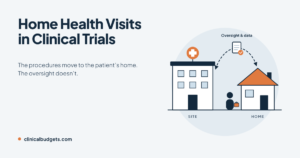

Home health care (HHC) visits look like a budget saving – a nurse goes to the patient’s house, the site doesn’t have to see them, so the site shouldn’t be paid for that visit, right?
In reality a home visit simply moves where the procedures occur, not where the responsibility lies. The PI is still accountable for the patient’s safety, and the coordinator still has to prepare the visit, chase the data and clean it up afterwards. If your budget treats a home visit as a zero for the site, you’re asking the site to do that work for free. Sites notice, and it usually comes back to you as an escalation, having everyone on the chain do extra work.
How Home Healthcare Visits Work in Clinical Trials
The FDA’s 2024 guidance on decentralized trials states that trials with decentralized elements must meet the same requirements for patient safety, data integrity, documentation and oversight as traditional site-based trials. Local healthcare providers can handle routine tasks within their scope, but research-specific tasks that need protocol or IP expertise must be done by trained trial staff, and investigators remain responsible for participant rights, safety and delegated tasks.
In budget terms, the procedures may move to a vendor, but the oversight stays at the site.
What Work Remains with the Site?
When a home health vendor performs the visit, here’s what typically still lands on the site:
Before the visit
- Completing the home visit request forms for the vendor
- Updating the IRT and arranging IP dispensing
- Filling out physician order forms or the equivalent set-up documents
After the visit
- Reviewing the source data the home nurse collected and entering it into the EDC
- Conducting or documenting follow-up on AEs and SAEs, as required by the protocol and site workflow
- Following up on changes to concomitant medications
- Checking ePRO compliance, and completing eCOA with the patient over a televisit where the protocol requires it
- Reviewing lab results from samples taken at home
- Filing source documents
- Resolving queries and signing off the CRFs.
How to Budget Home Healthcare Visits: Three Scenarios
1. The protocol says a vendor performs the home visits.
Take the procedures out of the site budget. Since the vendor is doing and billing them, leaving them in, risks double payment. Retain appropriate PI and coordinator compensation for the work that remains with the site. Where the budget uses full visit-level fees as a starting point, confirm that the expected site workload supports that approach. The site still has oversight and still has to review and record everything the vendor sends back.
2. The protocol doesn’t say who performs them.
Unfortunately, this happens more often than it should. If responsibility is unclear, I use 50% of the equivalent procedure fees as a provisional budgeting assumption, while retaining 100% of the PI and coordinator fees. This is a working estimate, not an industry standard: the actual cost will depend on which procedures the vendor performs and how much work remains with the site. Document the assumption and confirm the intended operating model with the study team as early as possible.
3. The site uses its own nurse.
Here the site does the work, so pay the home visit as you would the equivalent on-site visit. Don’t add a separate home visit column on top of the on-site one, or you’ll pay for the same visit twice. On top of the visit fee, I recommend budgeting for the nurse’s travel: time spent travelling, plus fuel and car use at the country’s standard mileage rate. Confirm whether the site requires additional procedures, training, or SOPs for home visits that need to be accounted for in the budget.
Common Home Visit Budgeting Mistakes
When I QC a budget with home visits, these come up again and again:
- No PI fee on home visits. The column exists, but the investigator’s oversight isn’t paid. Since the PI remains responsible for patient safety, that’s a gap.
- A reduced coordinator fee and an EDC fee, and nothing else. The site gets paid for data entry, but not for preparing the visit, reviewing source, or filing it.
- No adverse event assessment or con-med follow-up. Those conversations still happen, usually by phone, and someone at the site has to have them.
- Duplicate columns when the site uses its own nurse. An on-site visit and a home visit for the same timepoint, both fully paid.
Getting Home Visit Budgets Right
Done properly, home visits make patient participation easier, which helps enrolment and retention. That benefit only reaches the study if the site is on board. Budget the site’s remaining work honestly, document the assumption behind each home visit column, and you’ll avoid one of the more predictable escalations in a decentralized study.
If you want a structured way to catch gaps like these before a budget goes out, the Budget QC Checklist covers visit-level checks, including the ones above.
HHC Checklist
- Confirm who performs each procedure.
- Confirm which vendor activities are included in the vendor fee.
- Identify remaining PI oversight and coordinator tasks.
- Check AE/SAE follow-up and concomitant medication review.
- Confirm source review, EDC entry, and query resolution responsibilities.
- Check for duplicate on-site and home visit fees.
- Review site nurse travel time and mileage, where applicable.
- Document unresolved assumptions and confirm them with the study team.
Find out who I am and what I am fighting for.
If you agree, disagree, or think this is nonsense, email contact@clinicalbudgets.com
If you’d like me to cover a specific topic, you can suggest it here.